
You know the feeling. You're walking to a train, rinsing dishes, or lying down with earphones on, and the audio is there, but half your mind is elsewhere. A few seconds later, you realise you've missed the point, the joke, the name, or the turn in the story. That's usually not a hearing problem. It's a listening comprehension problem, and it shows up most sharply in ordinary life, not in a quiet classroom.
Table of Contents
- Why Listening Comprehension Fails in Everyday Moments
- Real listening needs context, not just exposure
- The Multi-Pass Listening Routine That Builds Real Skill
- Start before the audio begins
- Then listen for the gist
- Use the second pass for details
- Choosing Audio at the Right Difficulty Level
- A quick way to judge difficulty
- Active Listening Drills You Can Run on a Walk
- Shadowing and selective listening
- Prediction and brief dictation
- Audio-First Interactive Practice for Low-Screen Moments
- Why interactivity changes attention
- What makes it practical in motion
- Fitting Practice Into a Real Weekly Routine
- Use ordinary moments on purpose
- Keep the routine small and realistic
- Measuring Progress and Keeping the Habit
- What real improvement looks like
- Keep one simple record
Why Listening Comprehension Fails in Everyday Moments
A lot of people blame vocabulary when the underlying issue is timing, attention, and context. You hear a podcast while crossing a road, miss one sentence, and the rest starts to blur together. You catch the beginning of a meeting update, then someone in the room speaks over the speaker, and the key decision disappears.
That gap between classroom listening and real-life listening explains why standard advice often falls short. In daily life, people do not listen in perfect silence. They listen while cooking, commuting, waiting, tidying, or checking a screen with one eye. In those moments, the brain has to filter noise, hold onto the thread of the message, and decide what matters first.
Real listening needs context, not just exposure
Listening research has moved away from the old idea that more exposure alone is enough. A major shift has been towards metacognitive strategy training, with learners encouraged to predict, listen for gist, then revisit the audio for details such as names, dates, and arguments, rather than letting sound wash over them. That approach fits daily life much better, because it accepts that comprehension happens in stages, not all at once.
Practical rule: if you miss the point once, do not assume you are bad at listening. First ask whether the setting was too noisy, the clip too long, or the task too vague.
Pronunciation can make this feel unfair. A learner may understand words in print and still miss them in speech, especially when sounds shift across speakers and accents. The contrast is easy to hear in examples like what makes Irish pronunciation unique, where sound patterns show how listeners can lose track even when the language itself is familiar.
The habit to build is simple. Stop treating everyday listening as a pass or fail test. Treat it as a skill you can practise in the same places where it usually breaks.
The Multi-Pass Listening Routine That Builds Real Skill
One listen is rarely enough, and that's not a weakness. It's how the brain works when speech arrives quickly and only once. Teaching materials increasingly use a multi-pass routine because each pass narrows the task and gives the listener a cleaner job to do.
Start before the audio begins
Pre-listening is where you get your bearings. Look at the title, the topic, or a few key words, then predict what kind of language you're about to hear. If the clip is about travel, you might expect transport words, dates, or complaints. If it's a story, you might expect a setting, a problem, and a change.
That first step matters because it reduces the shock of raw audio. The listener is no longer trying to decode everything at once. They already have a small frame in mind.
Then listen for the gist
On the first real listen, ignore the temptation to catch every word. Your job is to answer one question, what is this mainly about? If someone is speaking about a delayed flight, the gist might be frustration and a new departure time. If it's a short story, the gist might be that a character found a clue and changed direction.
Use the second pass for details
The second listen is where names, dates, numbers, and reasons come into focus. This is the moment to notice the detail you missed the first time. A phone number, a place name, or one argument in a longer explanation becomes much easier when the overall shape is already familiar.
A final pass can then be used for reconstruction. Say the main idea out loud, or write a short summary from memory before checking the audio again. That last step helps retention because you're not just hearing the material, you're rebuilding it.
A short clip makes this cycle much easier to manage. A long clip tempts people to drift, while a small one lets them notice exactly where comprehension breaks down. That is the value of the routine, it turns a vague problem into a sequence you can repeat.
Choosing Audio at the Right Difficulty Level
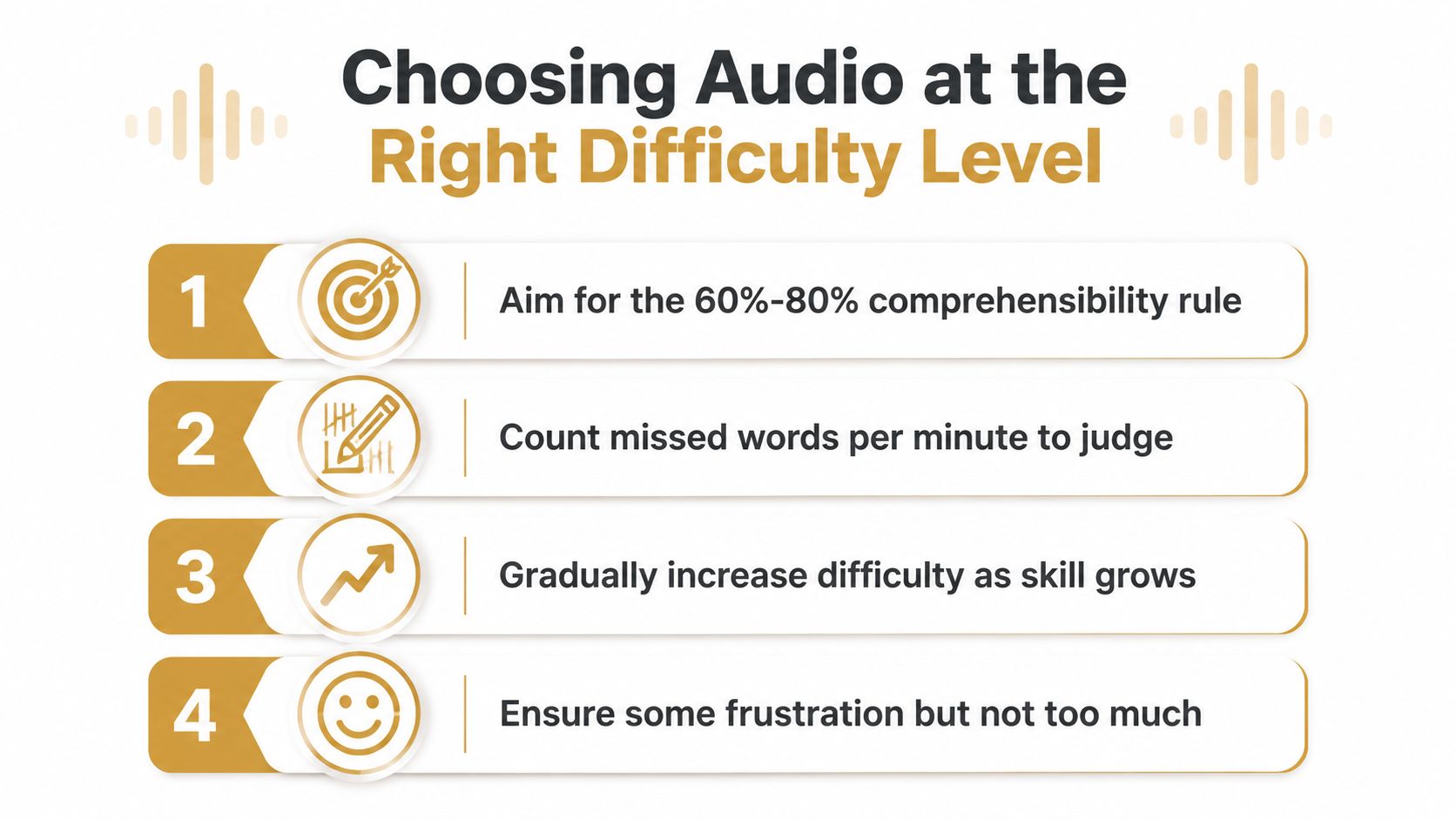
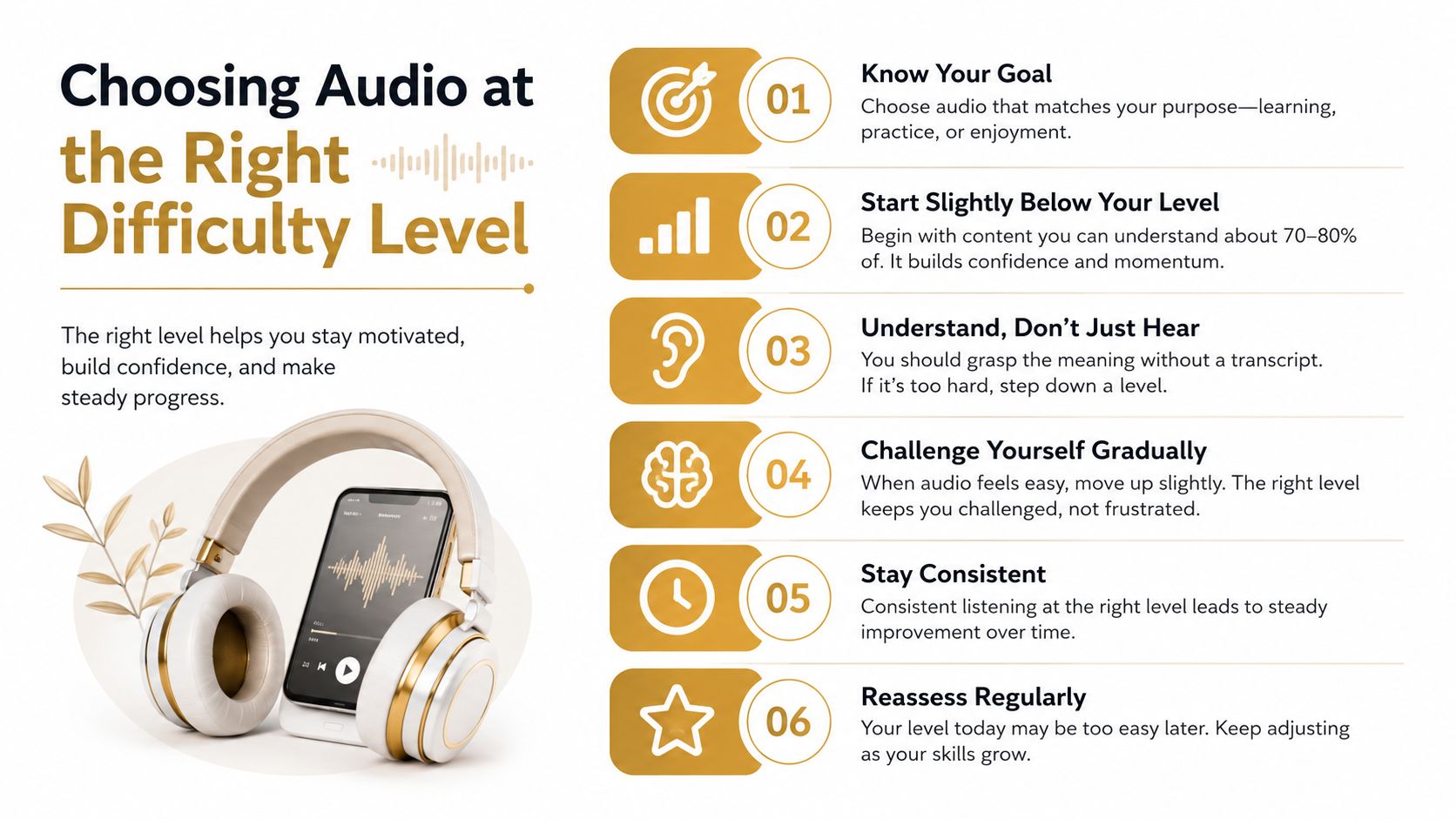
The clearest benchmark in the listening literature is the 60% to 80% comprehensibility rule. In plain English, the audio should already be mostly understandable before practice begins. If you can follow roughly that much, the clip is challenging without being hopeless, and the brain has enough hooks to build on.
That is why starting with a full broadcast or a fast, unfiltered podcast can backfire. The learner gets too many unknowns at once, then starts guessing instead of understanding. Smaller segments work better because they let you notice patterns, repeat them, and return to the same material with less strain.
A quick way to judge difficulty
Take a short clip, around 30 seconds, and listen once without stopping. Then count, roughly, how many words or ideas you missed. If the clip feels mostly clear but still leaves gaps, it is probably in the right zone. If almost everything feels blurred, it's too hard for now.
Useful standard: choose material that feels slightly frustrating, but still recognisable. If it feels like complete noise, your brain has nothing stable to work from.
Difficulty should rise across weeks, not days. A learner who jumps too fast from easy clips to dense speech often loses confidence and starts overthinking every unknown word. A steadier path is to stay with shorter, clearer audio until it begins to feel ordinary, then step up one level.
The point is not to avoid challenge. The point is to keep the challenge manageable so practice stays repeatable. That is how learners move from “I got lost immediately” to “I caught the main idea and some of the details.”
Active Listening Drills You Can Run on a Walk
Passive listening has its place, but it won't sharpen attention on its own. If you want a habit that works during a walk or a commute, you need drills with a clear job. The aim is not to work harder, it's to listen with purpose.
Shadowing and selective listening
Shadowing means speaking just behind the audio, even if you only copy a few words or a short phrase. It forces you to follow rhythm, speed, and sound changes instead of drifting. Use it with an easy clip, because the goal is timing, not perfection.
Selective listening works best when you choose one target, such as names, dates, or linking words. On one listen, ignore everything except the target. If you're listening to a conversation, for example, only catch every time the speaker says when, where, or who. That narrow focus trains the ear to search for something specific instead of everything at once.
Prediction and brief dictation
Prediction is simple. Pause before the next sentence and guess what kind of information is likely to come next. If the topic is travel delays, you might expect a new time, a platform, or an apology. You're not trying to be clever, just preparing your mind to hear actively.
Dictation exposes gaps very quickly. Play a few seconds, stop, and write what you caught. Then compare it with the original. Use this sparingly, because if you try to transcribe too much, the task becomes frustrating rather than useful.
A practical way to keep these drills honest is to use a study countdown timer so the practice stays short and focused. That matters more than people think. When a session has a visible end, it's easier to stay alert instead of wandering.
Listen for the sound you can catch, not the word you wish you heard.
For daily life, these drills work best in small doses. Ten minutes of careful listening will usually beat an hour of half-paying attention. The difference is not effort alone, it's the shape of the effort.
Audio-First Interactive Practice for Low-Screen Moments
Fixed audiobooks and podcasts are useful, but they always replay the same track. You hear the same scenes in the same order, which is fine for familiarity, but it can make listening habits stay passive. Audio-first interactive practice works differently, because the story responds to what the listener chooses.
Why interactivity changes attention
In a live audio adventure, the scene is built around the player's decisions. A choice can change the next character, the direction of the plot, or the ending itself. That keeps the listener alert in a way that passive replay can't, because each run asks, “What happens if I choose this?”
Gydel fits as a live AI audio adventure app. It isn't a podcast, an audiobook, a chatbot, or a normal mobile game. It builds stories live around the player's choices, with narration, music, and sound effects on paid audio plans, and it's designed for low-screen or screen-off moments such as walking, commuting, waiting, chores, relaxing, or bedtime listening.
What makes it practical in motion
This kind of audio-first play is easier to keep going when the phone can stay in the pocket. On supported devices, earphone hardware buttons can be used, but that depends on the earphones and the device itself. Spoken actions can also be queued before they are carried out, which helps reduce accidental commands and keeps control clear.
A useful comparison is this. Podcasts and audiobooks are fixed listening formats, so the listener adapts to the track. Interactive audio adapts to the listener instead. Traditional games often demand more screen time, while audio-first play keeps the focus on listening and choice rather than taps and menus.
If you want a broader look at the format, the material on Gydel's articles page sits in that same low-screen space and shows how audio-based practice can be folded into daily routines without turning into another scrolling habit.
The point isn't to replace every other listening method. It's to give the ear a fresh kind of work, one where attention has to stay live because the story is changing in response to you.
Fitting Practice Into a Real Weekly Routine
A weekly routine works best when it fits into moments you already have. A listening habit does not need a desk, a notebook, or a long block of free time. It needs a repeatable cue, a short audio piece, and a clear point to stop.
Use ordinary moments on purpose
A five-minute listen can happen before work or school, with the phone in your pocket and the screen off. A short walk can carry one clip and one simple task, such as replaying the same section and checking what changed on the second pass. Commutes work for the same reason, because the route gives the session a built-in start and finish.
Chores and bedtime can also hold practice. Washing up, folding laundry, or settling in for the night can each become a listening slot if the audio is short enough. The habit works better when the material is small and repeatable, which is why short clips are easier to return to than a one-time broadcast as described in this listening practice guide.
Keep the routine small and realistic
A simple routine is easier to keep than an ambitious one. Some guidance points to daily listening practice that is long enough to stay focused, while other guidance recommends a very short reflective session as noted in listening guidance. The exact length matters less than the habit of coming back to audio with attention, even on a crowded day.
A short session done regularly beats a long session that never comes back.
Hardware buttons on earphones can make that easier, because they let you pause or repeat without pulling out the phone. That depends on the earphones and the device, though, so it helps to test the controls before you rely on them. Less friction means fewer reasons to skip the habit when the week gets full.
The team behind Gydel's about page frames the product around low-screen listening, which matches the same idea. If the audio can stay in motion while your hands stay busy, practice becomes part of the day instead of a separate task.
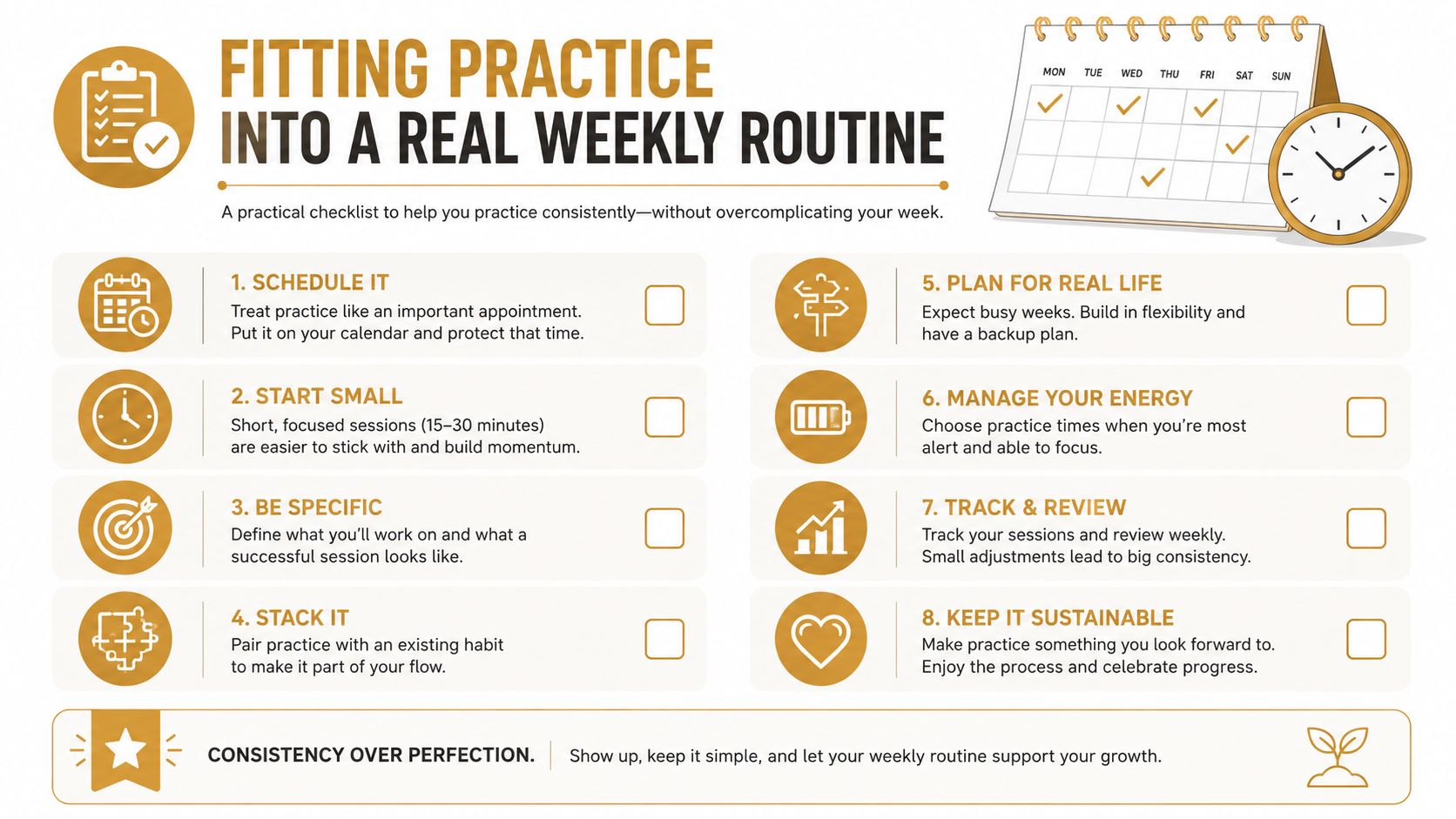
You do not need to plan every minute. Two dependable moments are enough to start, and once those moments feel natural, the weekly rhythm begins to hold on its own.
Measuring Progress and Keeping the Habit
Progress in listening usually feels slower than progress in reading, so it is easy to mistake slow change for no change at all. A better way to judge growth is to watch for signs that show up in real use. If you need fewer replays for the same clip, that is progress. If the main idea arrives faster on the first listen, that is progress too.
What real improvement looks like
A second pass should start to feel less surprising. Some details will still slip past, but the empty spaces in your understanding should shrink over time. Accents that once sounded blurry can begin to sound familiar because your ear has learned the patterns, pauses, and rhythm of the speaker.
Attention also matters. Research on mindfulness in education links better focus with stronger listening, and that fits what learners often notice in practice. A calmer mind is less likely to drift during a clip, which makes it easier to catch the meaning as it unfolds. The point is not to chase a shortcut. It is to see that steady attention and fewer distractions can change how much you understand.
Keep one simple record
Write down three things after a session. What was the main idea, what detail did you catch, and where did you lose the thread? That note does not need to be polished. It only needs to be clear enough that you can compare it with your next attempt.
Return to the same clip a week later and read your notes again. Small records often show progress more clearly than memory does, especially when the material is hard. A learner may feel stuck after one session, then see that the second listening comes with fewer pauses, fewer guesses, and less strain.
The habit itself should stay simple. Short practice done often, with a clear purpose, turns listening from a vague frustration into a skill you can build in ordinary moments.
Play a live AI audio adventure for spare moments, walks, commutes or bedtime. Open the app.